Mold Remediation in Castro Valley
Mold remediation in Castro Valley, CA. IICRC-certified, insurance billing accepted. Call (888) 379-1688.
Our IICRC-certified technicians are dispatched from our Hayward, CA location and are typically on-site in Castro Valley within 60 minutes of your call.
Mold behind a hallway closet wall or under a bathroom vanity rarely announces itself until the smell does. Castro Valley’s marine layer fog rolls in off the hills most mornings even when the rest of the East Bay is dry, and that daily humidity swing is exactly the kind of condition that lets mold colonize a damp subfloor or attic rafter long before a homeowner notices a stain. If you’re smelling something musty near a crawlspace vent or seeing dark specks creep across grout lines, the window to deal with it cheaply is closing, not opening.
Why Castro Valley Properties See Mold Issues
Castro Valley sits in unincorporated Alameda County along the I-580 corridor, where the terrain shifts fast from flat valley floor near Castro Valley Boulevard to steep hillside lots climbing toward the ridgeline. That topography matters for mold. Hillside homes often rest on raised foundations with crawlspaces that trap cool, moist air pushed in by the fog, and that moisture doesn’t evaporate quickly once it’s under the house. Meanwhile, the valley floor’s older ranch-style homes, many built during the postwar boom of the 1950s and 60s, tend to have original plumbing and tighter, less-ventilated bathrooms where steam condenses on ceiling drywall for years before a leak is ever found. Add in the East Bay’s wet winter months and a slow-draining yard, and you have the two main entry points for mold in this area: ground-level moisture intrusion and roof or plumbing leaks that go unnoticed inside a wall cavity.
Our Mold Remediation Process in Castro Valley
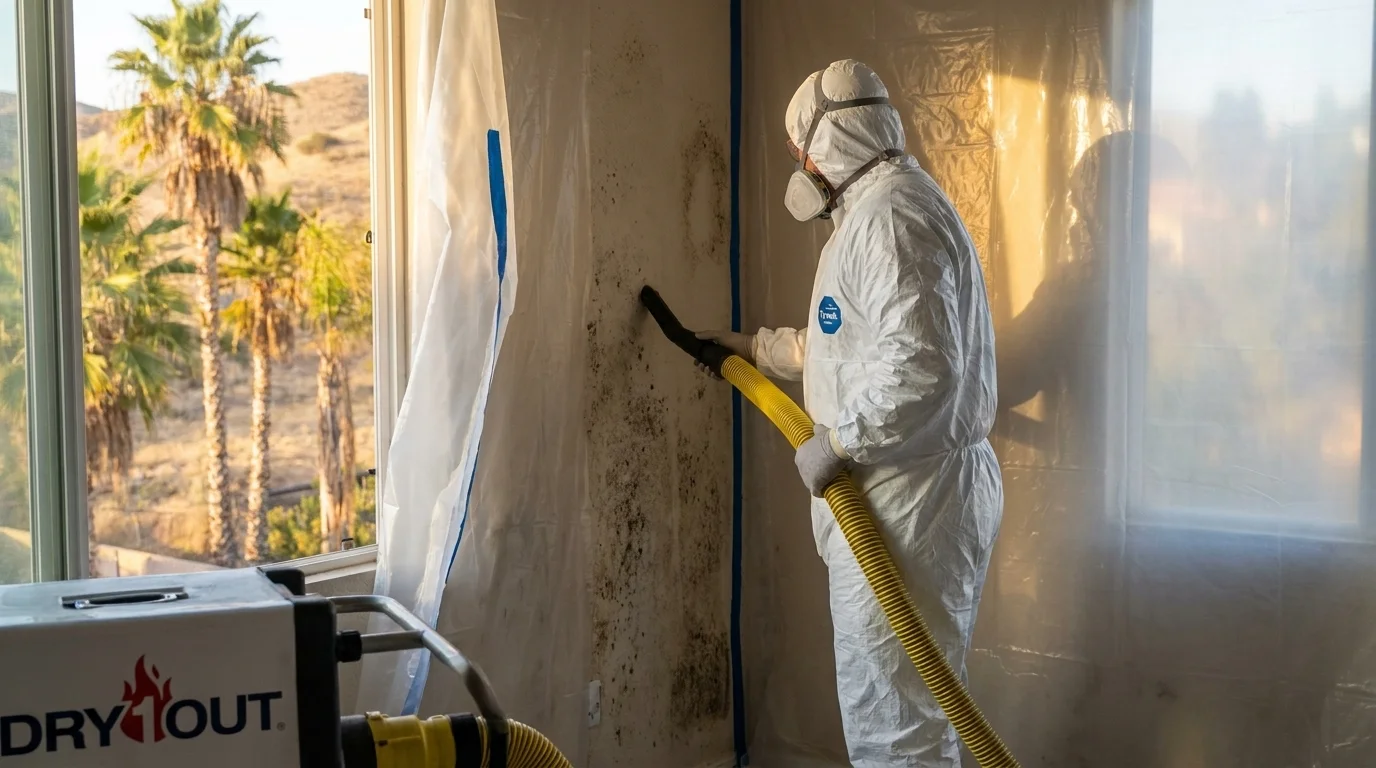
We start with containment, not demolition. Before anything is cut open, we seal off the affected area with physical barriers and negative air pressure so spores don’t travel into the rest of the house while we work, which matters more in homes with central forced-air systems that can pull contaminated air through the ductwork. From there we remove and bag the mold-affected material, whether that’s a section of drywall, subfloor, or insulation, following IICRC S520 guidance for handling and disposal. HEPA air scrubbers and negative air machines run through the drying phase, and we use moisture meters on the surrounding studs, joists, and subfloor to confirm the material underneath is actually dry, not just dry to the touch. For hillside homes with crawlspace access, we pay particular attention to the vapor barrier and any gaps in foundation venting, since that’s usually where the moisture is re-entering.
Reaching Castro Valley from Hayward
Our Hayward office at 2536 Barrington Ct sits just off the I-880/I-580 interchange, which puts most of Castro Valley, from the Castro Valley Boulevard commercial strip to the hillside neighborhoods off Redwood Road, within a straightforward drive east on I-580. That proximity means we’re not routing a crew across the bridge or down from a distant regional hub; we’re pulling from a team that’s already positioned on this side of the bay. We schedule mold inspections and remediation work with that geography in mind, which keeps project timelines realistic instead of padded for a longer commute.
Equipment & Methods We Use for Mold
Mold remediation isn’t just removal, it’s verification. Our technicians hold IICRC AMRT certification for mold remediation specifically, and the same crews carry IICRC WRT and ASD training, which matters when mold is the visible symptom of an underlying water intrusion problem that also needs to be dried out correctly the first time. We use thermal imaging to find moisture patterns behind walls without opening them unnecessarily, and air scrubbers rated for the square footage of the containment area rather than a one-size-fits-all unit. Once materials test dry and the visible mold is removed, we don’t just pack up: proper containment teardown and a final wipe-down of surfaces outside the work zone are part of closing out the job, not an afterthought.
Local note
Homes built into the hillsides on Castro Valley’s eastern side often have crawlspace foundations that trap condensation from the valley’s marine layer fog even during summer months, which means mold can establish at the subfloor level well before anything shows up on interior walls or ceilings. If your home sits on a slope and you’ve noticed a musty smell near a floor vent but no visible staining, that crawlspace is usually where we start looking first.
If you’re dealing with a musty smell, visible staining, or a known leak in a Castro Valley home, don’t wait on it to resolve itself. Call (888) 379-1688 and we’ll get a mold remediation plan moving before the colonization spreads further into the structure.
Serving Castro Valley from our Hayward location — ★ 5.0 · 26 Google reviews
“Excellent service love the owner” — Cesar, October 2026Read our reviews on Google →
Mold Remediation in Castro Valley: Service Coverage
Frequently Asked Questions
How fast can you arrive for mold remediation in Castro Valley?
How does Castro Valley's hillside terrain affect where mold shows up in a home?
Are older ranch-style homes in Castro Valley more prone to mold problems?
How quickly can your Hayward office respond to a Castro Valley mold job?
What's actually involved in mold containment during remediation?
Does mold remediation address the moisture source, or just remove the mold itself?
Will my homeowners insurance cover mold remediation in Castro Valley?
Mold Remediation response in Castro Valley
Most Castro Valley calls see a technician on-site within 60 minutes from our Hayward location.