
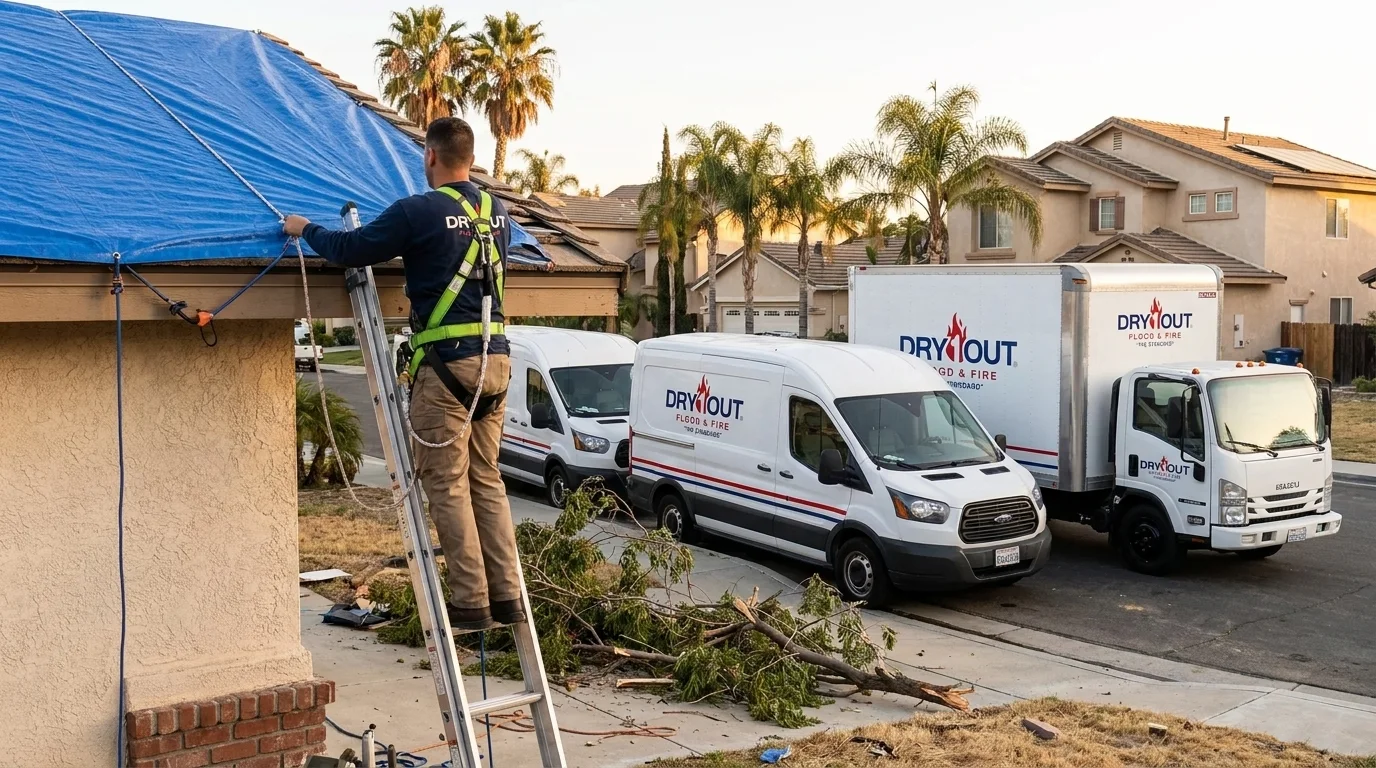
24/7 Emergency Storm Damage Restoration in San Francisco
24/7 emergency storm damage restoration in San Francisco, CA. IICRC-certified, insurance billing accepted. Call (888) 379-1688.
Our IICRC-certified technicians are dispatched from our Vista, CA headquarters and are typically on-site in San Francisco within 60 minutes of your call.
Storm damage emergency in San Francisco? Call (888) 379-1688 now, we answer 24/7. Wind-driven rain off the Pacific finds every gap in an older roofline fast, and once water gets behind siding or under a parapet wall in a fog-belt neighborhood, it doesn’t dry on its own. Dry 1 Out Restoration and Construction handles the extraction, structural drying, and board-up work that follows a Bay Area storm, from a cracked skylight in Noe Valley to a downed limb across a driveway near Golden Gate Park.
Why San Francisco Properties See Storm Damage Issues
San Francisco’s weather doesn’t bring the hail or straight-line winds you’d see inland, but it brings something just as damaging to older housing stock: sustained wind-driven rain combined with persistent fog-belt humidity. In the Sunset and Richmond Districts, where many homes date to the mid-20th century, flat or low-slope roofs and stucco exteriors were never built to shed the kind of sideways rain that comes off a Pacific storm system. Water doesn’t just pool, it gets pushed up under roofing material and behind siding, then sits there because the ambient moisture never fully evaporates. Mature street trees in Pacific Heights and Bernal Heights also take a beating in high wind events, and a limb or whole tree coming down on a roof or fence is one of the more common storm calls we see across the city. Steep terrain in neighborhoods like Bernal Heights adds another wrinkle: runoff that would simply soak into flat ground elsewhere instead channels toward foundations and garage-level entries.
Our Storm Damage Restoration Process in San Francisco
The first step is always stopping active intrusion, tarping a damaged roof section, boarding a broken window, or extracting standing water before it migrates into wall cavities. From there we assess what’s actually wet versus what only looks wet. A plaster wall in a pre-war Mission District flat can feel dry to the touch while the lath behind it is still saturated, which is why we use moisture meters and thermal imaging rather than guesswork. Drying follows the IICRC S500 standard, with air movers and dehumidifiers sized to the space, not a one-size-fits-all setup. In homes near the fog belt we typically run equipment longer than we would in a drier inland city, because ambient humidity slows evaporation even after the active leak is sealed. Once materials read dry, we move into repairs: drywall, flooring, roofing, and any structural framing affected by the storm.
San Francisco Insurance & HOA Coordination
A lot of San Francisco’s housing stock is multi-unit, think Edwardian and Victorian buildings converted into condos in SoMa and the Mission, which means storm damage often isn’t a single-owner decision. If a shared roof or exterior wall is involved, we document the loss with photos and moisture readings that your HOA board and property manager can hand straight to the association’s insurer, alongside your own carrier if your unit sustained interior damage. We bill most major carriers directly and can speak with adjusters about scope, which matters when a claim touches both an individual unit and common elements. For single-family homes, the process is simpler, but the documentation standard is the same: a clear record of what was wet, what we did, and why, written the way a carrier expects to see it.
Local note
Fog-belt moisture in the Sunset and Richmond Districts means a storm-damaged home there can still read “damp” on a moisture meter three or four days after the rain has stopped, longer than you’d expect in a sunnier part of the city like Noe Valley. We factor that lag into our drying timeline instead of pulling equipment early just because the forecast cleared, because a home that looks dry on day three but isn’t can set up conditions for hidden mold growth by the following week.
If a storm has pushed water into your walls, torn off roofing, or dropped a tree limb on your San Francisco property, don’t wait to see if it dries out on its own. Dry 1 Out Restoration and Construction is licensed (CA #993442) and insured, available around the clock, and ready to document, dry, and rebuild what the storm damaged, whether you’re in a Victorian flat in the Mission or a ranch home a few blocks from Ocean Beach.
Serving San Francisco from our Vista headquarters — ★ 5.0 · 18 Google reviews
“As good as it gets… fast, friendly put my mind to ease…” — Doug, September 2026Read our reviews on Google →
Storm Damage Restoration in San Francisco: Service Coverage
Frequently Asked Questions
How fast can you arrive for storm damage restoration in San Francisco?
How does San Francisco's fog-belt humidity affect storm damage drying in the Sunset and Richmond Districts?
Do shared roofs in Mission District or SoMa condo buildings complicate a storm damage claim?
Are older homes in Noe Valley or Bernal Heights more vulnerable to storm damage than newer construction?
What's different about drying a storm-damaged plaster wall versus drywall in San Francisco's older flats?
Can you coordinate with my insurance adjuster for storm damage near Golden Gate Park or Ocean Beach?
Storm Damage Restoration response in San Francisco
Most San Francisco calls see a technician on-site within 60 minutes from our Vista headquarters.
Nearby & Related
- 24/7 Emergency Storm Damage Restoration in Vista
- Restoration Services in San Francisco
- 24/7 Emergency Fire Damage Restoration in San Francisco
- Mold Remediation in San Francisco
- 24/7 Emergency Storm Damage Restoration in Oakland
- 24/7 Emergency Storm Damage Restoration in Oceanside
- Contact Dry 1 Out Restoration and Construction