
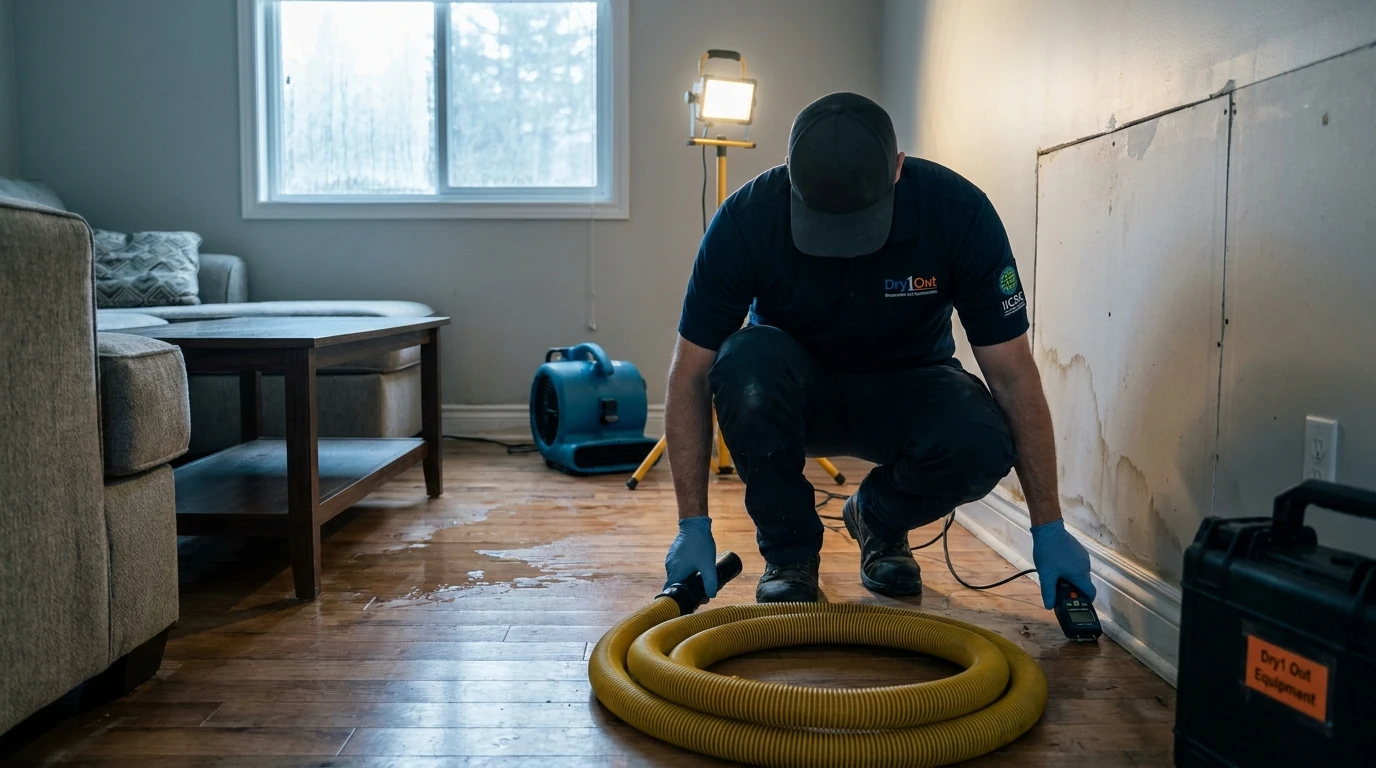
If water damage just happened to your home, here’s what matters most in the first 24 hours: stop the water source, get people and pets safe, shut off electricity to wet areas, remove what you can to dry ground, and start documenting everything before you touch or move anything else. Mold can begin colonizing damp material in as little as 24 to 48 hours, so the clock that matters isn’t your to-do list, it’s the biology happening inside your walls and under your flooring. The steps below are in the order they actually need to happen, not the order that feels most urgent emotionally.
Understand What You’re Dealing With
Not all water damage behaves the same way, and knowing which category you’re in changes what’s safe to do yourself.
Clean water (a supply line, a toilet tank, rainwater through a roof leak) is the lowest risk. You can usually handle initial cleanup yourself if the volume is small.
Gray water (washing machine overflow, dishwasher discharge, a sump pump backup) carries some contamination. Treat it with gloves and don’t let it sit.
Black water (sewage backup, floodwater from outside, any water that’s been standing for days) is a biohazard. Don’t wade into it, don’t let kids or pets near it, and don’t try to clean it up with household supplies. This category needs a professional, period.
If you’re not sure which category you’re looking at, assume the more serious one. A puddle that looks clear can still be carrying contamination from a cracked sewer line or a flooded crawlspace.
The First Hour: Stop the Damage From Spreading
- Shut off the water source. If it’s a burst pipe or supply line, find the fixture shutoff valve first; if you can’t locate it or the leak is from an unknown source, shut off the main water valve to the house.
- Cut power to affected rooms at the breaker, not just the light switch, if water is anywhere near outlets, cords, or appliances. Water and electricity sharing the same room is the fastest way this situation gets worse.
- Move people and pets out of standing water, especially if it’s gray or black water.
- Photograph everything before you move anything. Wide shots of the room, close-ups of the water line on walls and furniture, the source of the leak if visible. Insurance adjusters rely heavily on this early documentation, and you won’t remember details clearly once you’re three days into cleanup.
- Remove items sitting directly in water: rugs, boxes, furniture legs, anything with cardboard or particleboard touching the floor. These materials wick water upward and will not survive sitting wet.
The Next Few Hours: Slow the Absorption
Once the active flooding has stopped, the fight shifts to limiting how deep the water gets into your building materials.
- Open windows if the outdoor humidity is lower than indoors, otherwise keep them closed and run a dehumidifier or AC if you have one.
- Pull up wet carpet padding if you’re able to safely. Carpet itself can sometimes be saved, but padding almost never survives a saturation event and holds water against the subfloor the longer it sits.
- Prop up furniture on foil or wood blocks to stop legs from wicking moisture and to let air circulate underneath.
- Check drywall for sponginess by pressing gently, not punching holes. If it gives under light pressure, water has already traveled up inside the wall cavity, which usually means more than a surface wipe-down is needed.
- Listen for sounds under flooring. A soft, hollow, or squishy feel when you walk across laminate or hardwood is a sign water has gotten underneath, even if the surface looks dry.
If the water came from outside (storm surge, a yard that doesn’t drain, a creek overflow near your property), be aware that Vista’s clay-heavy soil in many neighborhoods holds water longer than sandy soil does, which means saturated ground near your foundation can keep feeding moisture into a crawlspace or slab edge for days after the rain stops.
What Not to Do
- Don’t run a ceiling fan if the ceiling itself is wet. A waterlogged electrical box is a fire and shock risk.
- Don’t use a regular shop vac rated for dry debris only on standing water unless it’s specifically rated wet/dry. Check the label.
- Don’t paint over or seal a water stain to make it look better before documenting it. Insurers want to see the original condition.
- Don’t assume a surface that feels dry to the touch means the material underneath is dry. Drywall, subfloor, and framing lumber can hold moisture well below the surface for days; this is why professional drying uses moisture meters, not guesswork.
- Don’t wait on mold you can already smell. A musty, earthy odor showing up within the first day usually means moisture has already reached somewhere you can’t see, like inside a wall cavity or under flooring.
When to Call a Professional
Call a restoration company rather than handling it solo if any of these apply:
- The water is gray or black water (sewage, flooding, backup).
- Water has reached drywall, insulation, or subflooring, not just the surface of flooring or carpet.
- The affected area is larger than a small room, or water has traveled between floors.
- You can’t identify or stop the source yourself.
- It’s been more than a day since the water event and you’re still smelling mustiness or seeing discoloration.
Dry 1 Out Restoration and Construction works with Vista homeowners on water damage restoration, including moisture mapping, extraction, and structural drying handled to the IICRC S500 standard that governs how water losses are supposed to be dried. If you’re filing an insurance claim, a professional inspection also gives you documented moisture readings that carry more weight with an adjuster than your own photos alone.
What Recovery Actually Looks Like After Day One
Once the immediate crisis is handled, drying out a structure properly usually takes several days, not hours, even when things look dry on the surface after 24 hours. Professional drying relies on air movers and dehumidifiers running continuously, with moisture readings checked daily in affected materials until they return to a normal range, not just until the carpet feels dry underfoot. Baseboards sometimes need to come off, and in some cases a section of drywall gets cut out, not because the damage looks severe, but because wall cavities trap moisture that will cause problems weeks later if it isn’t addressed now. If the home has hardwood flooring, specialized drying mats are sometimes used to pull moisture out from underneath without pulling up the whole floor. Expect this phase to run anywhere from a few days to over a week depending on how much material got wet and how deep the water traveled.
The first 24 hours determine how much of this longer process you can avoid. Fast, correct action now is the single biggest factor in whether your materials get salvaged or replaced.
If you’re standing in water right now and trying to figure out next steps, a call to a local restoration company costs you nothing but a few minutes, and it gives you a clearer read on whether this is a do-it-yourself situation or one that needs equipment and expertise you don’t have in your garage. Dry 1 Out Restoration and Construction can be reached at (888) 379-1688 to talk through what you’re seeing and what to do next.